Signs your fuse box needs replacing
You might be thinking about a new board because of what you can see: rewireable fuses with fuse wire, a wooden backboard, an old plastic unit with no spare ways, or no RCD protection. Sometimes it comes up because something else is planned, such as a kitchen refit, an extension, an EV charger or a heat pump, and the existing board cannot take the extra circuits. An EICR may also recommend an upgrade. Frequent nuisance tripping, scorch marks or a burning smell are different: they point to a fault that needs investigating straight away, not just a new box. None of these signs tell you what the job will involve on their own. That comes from looking at the board, the circuits and the earthing.
Board size and number of circuits
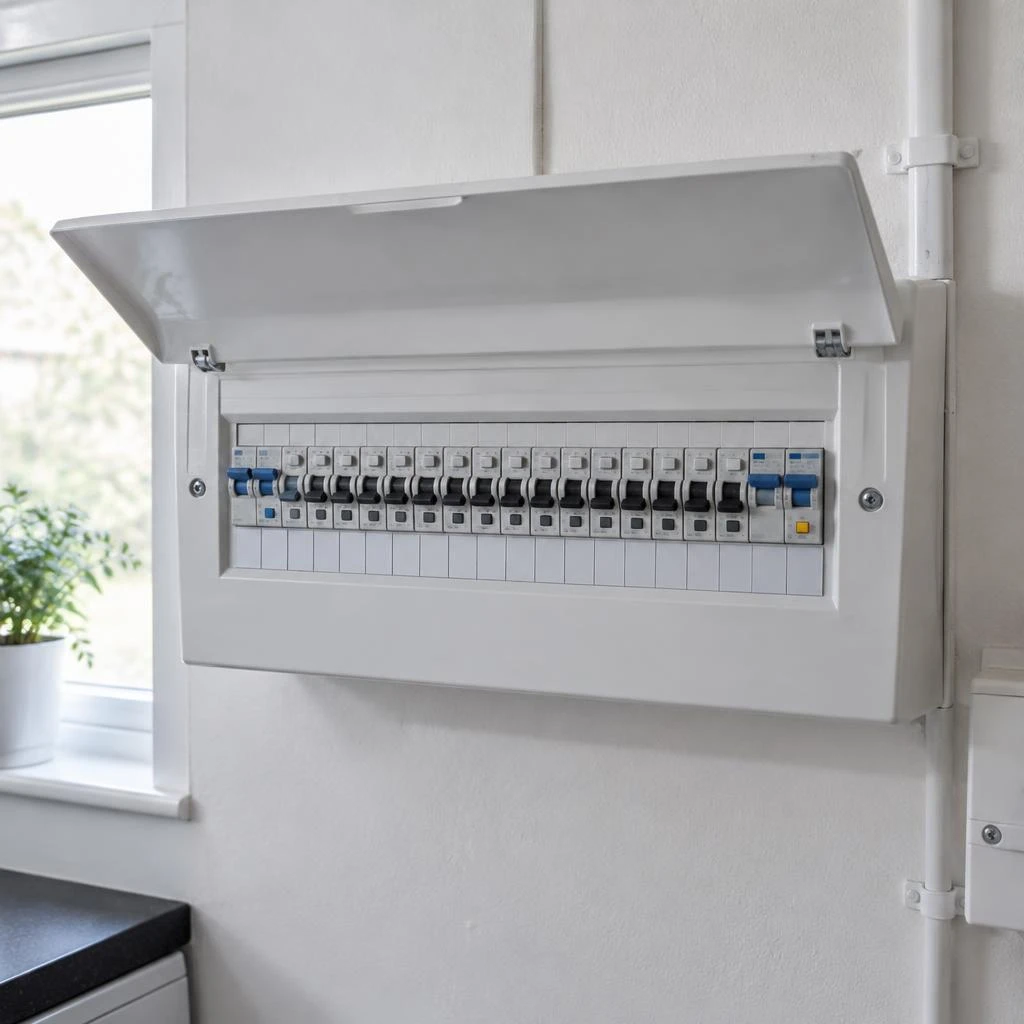
A consumer unit is sized by the number of ways, or spaces, for protective devices. A small flat might need only a few circuits, while a larger house with an electric shower, cooker, extension, outbuilding and charger needs many more. More circuits mean a larger board, more devices and more testing. It is usually sensible to allow a couple of spare ways for the future. The position of the board matters too. If it needs moving, perhaps because it sits in an awkward spot or above a doorway, the meter tails and circuit cables have to be extended or rerouted, which adds work.
Testing before and after, and faults that show up
A new consumer unit cannot simply be connected to whatever wiring is already there. Each circuit is tested, and modern protection is more sensitive than old fuses. That is a good thing, but it means hidden faults often come to light. Common examples include damaged insulation, a neutral shared between two circuits, water in an outside light or a nail through a cable. An old fuse might have tolerated these for years. An RCD or RCBO will not. Any fault has to be found and fixed before the circuit can be safely connected, so it is fair for a quote to explain how unexpected faults will be handled. A good electrician will tell you what they find and agree the next step with you before going further.
RCD and RCBO protection, and surge protection
Modern boards use RCDs to protect against electric shock and earth leakage. One common design uses two RCDs, each covering a group of circuits. Another uses RCBOs, which combine a circuit breaker and RCD in one device for each circuit, so a fault on one circuit does not trip others. RCBO boards cost more in parts but can be more convenient day to day. Our guide comparing RCBO and dual RCD boards explains the difference in more depth. Surge protection devices are now commonly fitted to guard against voltage spikes. Whether one is required depends on an assessment under the wiring regulations, and your electrician should explain the choice. Domestic consumer units are now generally made with metal enclosures, or housed in a non-combustible enclosure, to meet current requirements.
Bonding and other upgrades sometimes needed
The consumer unit is only one part of a safe installation. Main protective bonding connects incoming metal services, such as gas and water pipes, to the main earthing terminal. If it is missing or undersized, it will usually need bringing up to standard as part of the work. The earthing arrangement itself may need checking with the network operator. Meter tails, the cables from the meter to the board, sometimes need replacing if they are old or too small. These items can affect the overall scope, and it is better to know about them at the quote stage than on the day.
Certification and getting an exact quote
Replacing a consumer unit in a home in England is notifiable work under Part P of the Building Regulations. An electrician registered with a competent person scheme can self-certify it, issue an Electrical Installation Certificate and arrange for the work to be notified to building control. Keep those documents. You will need them if you sell or let the property. To get an accurate quote, share a photo of your current board and meter, tell the electrician roughly how many bedrooms and any extensions, and mention any future plans such as a charger. Sean Reynolds at SR Installations (Electricals) is NAPIT registered with 20 years in the trade. Call 07747 562927 or use the contact page and he will explain what your property needs.