
Two kinds of protection in plain English
Electrical circuits need protection suited to the faults they may experience. Overcurrent protection responds to overloads or short circuits. Residual current protection detects certain leakage conditions and helps reduce electric shock risk by disconnecting the supply. A consumer unit can arrange these functions in different ways. The device names are useful, but understanding which circuits share protection matters just as much. No arrangement removes the need for sound wiring, correct earthing and suitable installation work. Think of the consumer unit as part of a system rather than a box that can make every old circuit safe without testing.
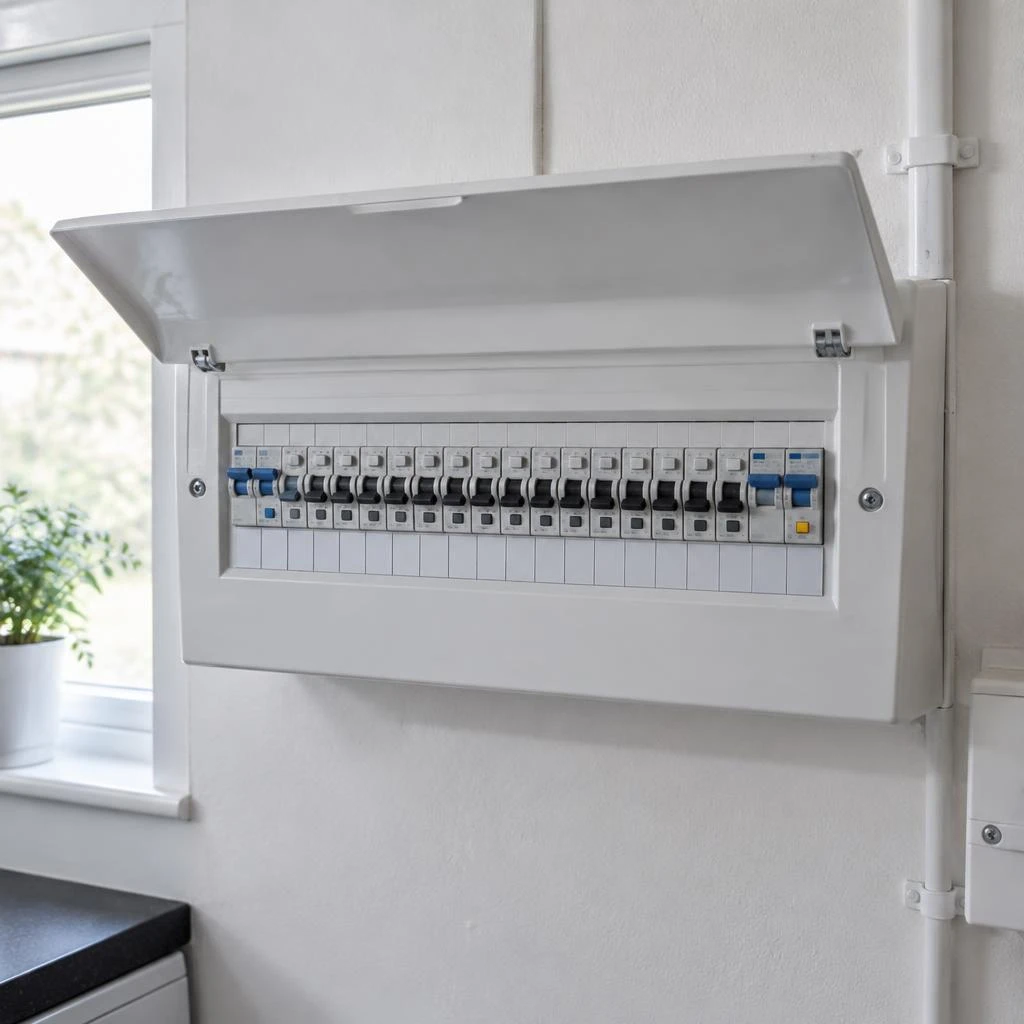
How a dual RCD board is arranged
In a typical dual RCD consumer unit, groups of circuits share a residual current device, with individual overcurrent protection for the circuits. If a fault causes one RCD to operate, more than the faulty circuit may lose power because they are in the same group. That can be inconvenient when unrelated lights or sockets are affected. The exact circuit split matters and should be considered in the design. The term dual RCD does not tell you which parts of your home will share a device. Ask how the proposed layout works in practical terms instead of assuming that two RCDs means every circuit has independent protection.
How RCBO circuits differ
An RCBO combines residual current and overcurrent protection in one device for an individual circuit. A fault on that circuit can therefore be disconnected without relying on a residual current device shared by a whole group. This can make fault isolation more local to the affected circuit, subject to the full installation arrangement. The incoming supply and other faults can still interrupt power to the home. The device must also be suitable for the circuit and requirements. The important benefit to discuss is the way circuits are separated, not a claim that one product eliminates every possible interruption.
What changes when a fault occurs
Imagine a fault on a socket circuit while lighting is in use. With shared residual current protection, circuits in the same group may be disconnected together. With suitable individual RCBO protection, the effect can be confined more closely to the affected circuit. That practical difference is why separation is useful to understand. It also influences how faults can be investigated and how much of the property is interrupted. The final behaviour depends on the installation design and type of fault, so examples describe possible outcomes rather than a prediction for your home. Sean can explain the intended circuit arrangement for the actual home rather than a generic diagram.
Which arrangement suits your home?
The number of circuits, existing installation, planned additions and relevant requirements all influence the design. A charging circuit, an extension or particular equipment may need specific consideration. There are also different types of residual current protection, and product selection must suit the loads and applicable standards. Homeowners should not be left to choose solely from a price comparison between two board labels. Ask why the proposed equipment is appropriate, how circuits will be arranged and what the work includes. A professional design should reflect BS 7671 and the actual installation, not a marketing assertion that the same board suits every property.
Testing before replacing the consumer unit
New protection can reveal existing problems such as insulation faults or incorrect neutral arrangements. Testing retained wiring is therefore important before relying on it with a new board. If issues are found, they need explanation and an appropriate remedial plan. Replacing the enclosure alone does not address all possible faults hidden along circuits. A prior EICR may help establish the wider condition, but the replacement work has its own testing and certification requirements. Keep both kinds of documentation together. If widespread wiring problems are identified, rewiring may need discussing rather than assuming a different protective device is the solution.
Questions worth asking before the upgrade
Ask which circuits are included, what protection is proposed and why it suits the property. Find out how the power-off arrangements will be planned, what happens if testing finds faults and what documentation will be supplied. Mention any new electrical loads you are considering so they can be included in the assessment. You can read more on the consumer unit replacement and old fuse box pages, or start with an EICR if the condition of the installation is unclear. A quote request should describe the property and reason for the upgrade. That gives Sean useful information for a practical discussion rather than asking you to decide the technical design alone.
A comparison is not a wiring specification
The examples in this guide explain a practical difference but cannot determine the equipment required for your home. Actual devices, ratings and arrangements depend on the installation and relevant requirements. Do not buy parts or alter a board based only on a general comparison. Bring the questions to Sean instead, along with any inspection report and planned electrical additions. The aim is to understand the proposal, not to turn a homeowner into the designer of circuit protection or encourage work inside electrical equipment.